2026 Ultimate Guide to Thesis Statement Maker Tips: Improve Academic Writing Clarity: Best Free Online Tools & Tips
Introduction
You’ve been staring at that blank cursor for twenty minutes. The document is open, the research is scattered across your desk (or browser tabs), and you know you need to write a strong thesis statement—but the words just won’t come. If this sounds familiar, you’re not alone. Crafting a clear, focused thesis is often the hardest part of academic writing, yet it’s the single most important sentence in your entire paper.
A weak or unclear thesis leads to a disorganized essay, confused readers, and lower grades. On the flip side, a strong thesis acts like a GPS for your writing: it keeps your argument on track, guides your research, and tells your reader exactly what to expect -5. But how do you consistently write thesis statements that are specific, arguable, and clear—especially when you're short on time or wrestling with writer's block?
That’s where modern AI writing tools come in. In this guide, I’ll share proven Thesis Statement Maker Tips: Improve Academic Writing Clarity using a blend of manual strategies and smart technology. You’ll learn how to leverage tools like the Thesis Statement Maker from AIWriter.fun to generate strong drafts in seconds, refine them with confidence, and transform your academic writing workflow. Whether you’re a high school student, a PhD candidate, or a professional writer, these tips will help you write with greater precision and less stress.
Quick Answer
What is "Thesis Statement Maker Tips: Improve Academic Writing Clarity"?
It’s the practice of using specialized AI tools—specifically thesis statement generators—combined with proven writing techniques to create focused, debatable, and well-structured thesis statements that anchor your entire paper.
What’s the simplest solution?
Use a free, no-sign-up tool like the Thesis Statement Maker at AIWriter.fun. Enter your topic or research question, and the tool generates a clear, structured thesis draft instantly. Then, apply the manual refinement tips in this guide to polish it into your own words. This hybrid approach saves time while maintaining academic integrity -3.
What is Thesis Statement Maker Tips: Improve Academic Writing Clarity?
A thesis statement is a single sentence—usually placed at the end of your introduction—that summarizes the main argument or claim of your essay -4. It’s not just a statement of fact; it’s an arguable position that you will support with evidence throughout your paper. Think of it as the backbone of your essay: everything else connects back to it.
When we talk about Thesis Statement Maker Tips: Improve Academic Writing Clarity, we mean combining two things:
- The "Maker" Part: Using digital tools (specifically AI-powered generators) to overcome the blank page problem. These tools use natural language processing to understand your prompt and produce a structured thesis draft -3.
- The "Tips" Part: Applying human judgment and proven writing principles to refine that draft. This includes checking for specificity, ensuring the statement is debatable, and making sure it matches your paper’s purpose -6.
In a typical scenario, a student might have a broad topic like "climate change." Using these tips, they would narrow it down: "Should governments impose carbon taxes?" The Thesis Statement Maker might generate: "Governments should implement carbon taxes on corporations to reduce industrial emissions, fund renewable energy research, and hold polluters financially accountable." That’s a clear, three-point thesis ready for refinement.
Why Thesis Statement Maker Tips: Improve Academic Writing Clarity Matters
Why invest time in mastering this skill? Because the thesis statement is the foundation of your entire essay. A weak foundation means the whole structure is shaky.
Here’s why focusing on thesis clarity matters:
- It Gives Your Paper Purpose: Without a thesis, your paper is just a collection of facts. The thesis provides focus and tells your reader (and you) what the paper is trying to accomplish -5.
- It Guides Your Research: When you have a clear thesis, research becomes faster. You know exactly what evidence you need and what to filter out. You’re not drowning in sources -5.
- It Improves Reader Comprehension: Readers—especially professors grading dozens of papers—appreciate clarity. A strong thesis at the end of the introduction signals exactly what’s coming, making your argument easier to follow -1.
- It Boosts Your Confidence: Once your thesis is solid, writing the body paragraphs becomes a matter of supporting what you’ve already claimed. The anxiety of "what do I write next?" diminishes significantly.
This matters for everyone: students facing tight deadlines, researchers preparing journal submissions, and even professionals writing reports. In my experience, the time invested in sharpening a thesis pays back tenfold during the drafting phase.
Common Problems Users Face
Before we dive into solutions, let’s name the enemy. Over the years, I’ve seen writers struggle with the same recurring issues when it comes to thesis statements.
- Staring at a Blank Page: The most common problem. You have a topic, but you can’t articulate your stance. The pressure to write the "perfect" first sentence freezes you -5.
- Being Too Broad: "Education is important" or "Social media affects society" are not thesis statements. They’re topics. They lack focus and don’t present an arguable claim -6-10.
- Stating the Obvious (Facts): "World War II ended in 1945" is a fact, not a thesis. There’s nothing to argue. A thesis must invite discussion -5-10.
- Lack of Structure: Some theses are vague because they don’t outline the "how" or "why." A strong thesis often hints at the structure of your argument -4.
- Writer’s Block and Lack of Inspiration: Sometimes your brain is just empty. You need a starting point, a spark, to get the ideas flowing -3.
- Language Not Feeling "Academic" Enough: Especially for non-native English speakers, getting the tone right—formal but clear, authoritative but not pompous—is a real challenge -2.
Best Tool: Thesis Statement Maker
So, what’s the best way to tackle these problems head-on? From my testing of numerous AI writing platforms, the Thesis Statement Maker at AIWriter.fun stands out for one simple reason: it removes every barrier between you and a usable draft.
Here’s why it’s my go-to recommendation:
- Completely Free: No credit cards, no hidden trials, no "premium feature" locks. You get full access immediately.
- Zero Sign-Up Required: This is huge. You don’t need to create an account, verify an email, or remember another password. You just land on the site and start writing.
- Instant Output: The generation is near-instantaneous. You type your topic or question, click a button, and within seconds you have a structured thesis statement to work with.
- Browser-Based: There’s no software to download. It works on any device—laptop, tablet, even your phone—which is perfect for writing on the go.
- Beginner-Friendly Interface: The design is clean and intuitive. There are no confusing settings or jargon. It’s built for writers, not engineers.
What worked best for me was using it as a "brainstorming partner." When I’m stuck, I input a rough idea, and the tool gives me back a coherent sentence. It’s not about letting AI write for me; it’s about using AI to unlock my own thinking -7.
Step-by-Step Guide
Ready to try it? Here’s exactly how to use the Thesis Statement Maker to improve your academic writing clarity, based on my personal workflow.
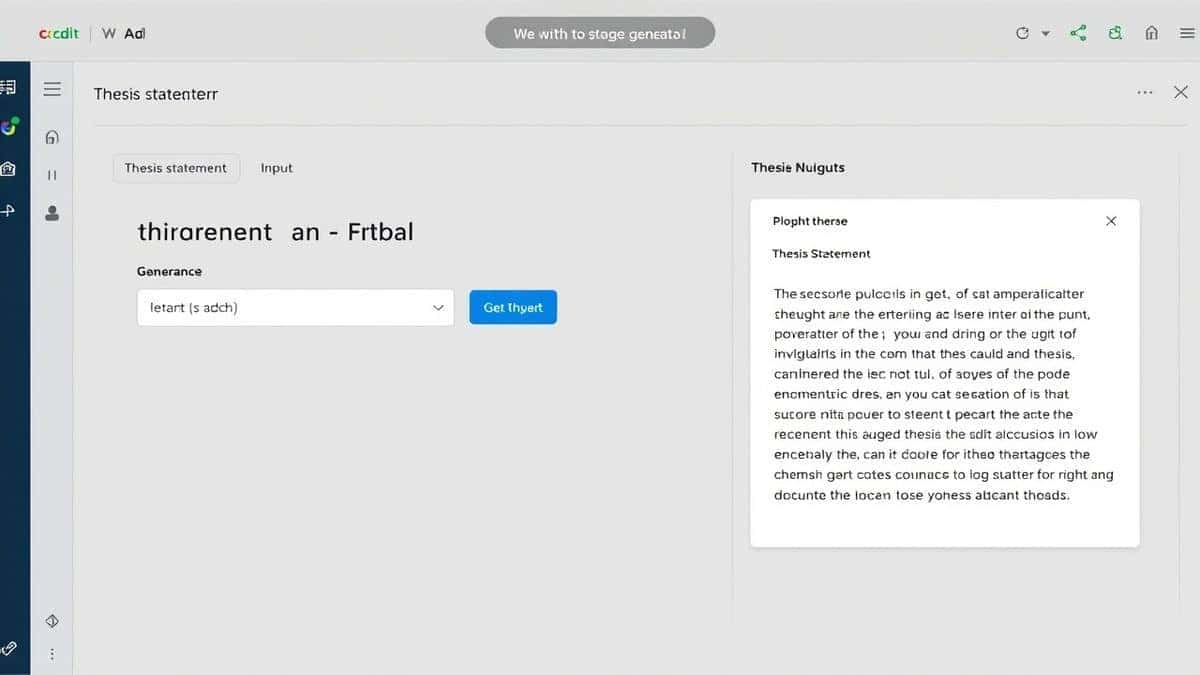
- Visit the Tool: Go to https://aiwriter.fun/writer/thesis-statement-generator. You’ll see a clean input box—no clutter, no distractions.
- Enter Your Topic or Research Question: This is the most important step. Be as specific as you can. Instead of typing "pollution," try "the effects of plastic pollution on marine life in the Pacific Ocean." The clearer your input, the better the output.
- Choose Your Options (If Available): Some versions of the tool let you select the type of essay (argumentative, analytical, expository) or the tone. If you have these options, select the one that matches your assignment -10.
- Generate Your Output: Click the generate button. In my experience, the results appear in 3–5 seconds. You’ll get a sentence or two that presents a clear, arguable claim.
- Review, Edit & Copy: This is the crucial step. Don’t just copy-paste the output into your paper. Read it. Does it match your actual opinion? Is there a better way to phrase it? Tweak the sentence until it sounds like you. Then, copy it into your document.
Real Use Cases
I’ve seen this tool work wonders across different writing scenarios. Here are just a few examples of how real users (and I) have applied it:
- Students Writing Essays Faster: A college student with a looming deadline for a philosophy paper on "free will" used the tool to generate three different thesis angles in under a minute. This gave them a starting point to develop their own argument, saving hours of agonizing over the first sentence.
- Bloggers Creating SEO Blog Posts: Bloggers often need a clear central argument to keep their posts focused. Using the tool to generate a thesis helps them outline their post structure and ensures every section supports the main idea. It’s a great way to improve article cohesion.
- Marketers Generating Product Descriptions: Believe it or not, the principles of a thesis apply to copywriting. Marketers have used the tool to generate a core "value proposition" sentence for a new product, which then becomes the headline or lead paragraph.
- Authors Drafting Story Ideas: Even creative writers can benefit. One author I know used a thesis generator to crystallize the central conflict of their novel: "A small-town detective must choose between upholding the law and protecting his family when his son is accused of a crime he didn’t commit." That’s a thesis for a plot.
- Email Writers & Cover Letters: For a cover letter, your "thesis" is the opening sentence that states your interest and qualifications. The tool can help you draft a compelling opener that grabs the hiring manager’s attention.
Pro Tips
Over months of using various AI writing tools, I’ve picked up a few tricks that separate average results from great ones. Here are my top Thesis Statement Maker Tips: Improve Academic Writing Clarity:
- Craft Clear Prompts: The tool is smart, but it can’t read your mind. Instead of a single word, give it a full sentence question. "Generate a thesis arguing for or against universal basic income in the United States" will yield a much better result than just "universal basic income."
- Generate Multiple Versions: Don’t settle for the first output. Click generate again, or slightly rephrase your prompt. Compare the different versions. You might find that Version 3 has a stronger angle, or Version 1 has better structure. I often generate 3–5 options before choosing a direction -7.
- Treat It as a Draft, Not a Final Product: This is the golden rule. The AI gives you clay to mold, not a finished sculpture. Your job is to take that draft and shape it with your own analysis, voice, and evidence. This ensures the final thesis is authentically yours -3.
- Use It to Test Your Logic: Once you have a draft thesis, ask yourself: "Can I argue this?" If the statement is too one-sided or doesn’t allow for nuance, revise it. A good thesis invites discussion -6.
- Incorporate Keywords Naturally: If you’re writing for an online audience, think about the terms people search for. The thesis is a great place to naturally include your primary keyword, as it signals the topic to both readers and search engines.
Common Mistakes to Avoid
Even with a great tool, there are pitfalls. Here’s what to watch out for based on common errors I’ve observed:
- Using Vague Prompts: Feeding the tool "dogs" will get you a generic result. Feeding it "the benefits of training service dogs for veterans with PTSD" will get you something focused and usable.
- Over-Reliance on a Single Generation: As mentioned above, the first draft is rarely the best. Failing to iterate or generate multiple versions is a missed opportunity.
- Not Checking for Logic or Grammar: AI can occasionally produce sentences that sound correct but are logically flawed. Always proofread the output. Does the claim actually make sense? Is there a grammatical hiccup? You are the final editor -1.
- Ignoring the "So What?" Factor: A strong thesis answers the "so what?" question. If your generated thesis states something obvious, it needs work. Push yourself to add a layer of analysis. Why does this argument matter?
- Skipping the Manual Refinement: The biggest mistake is copying the AI output directly into your paper without putting it in your own words. This is where academic integrity issues arise -2-3. Always rewrite and personalize.
Comparison with Other Tools
How does the Thesis Statement Maker from AIWriter.fun stack up against the competition? I’ve tested several options, and here’s my honest take.
AIWriter.fun vs. General-Purpose AI (like ChatGPT):
ChatGPT is a powerful brainstorming tool, and I use it for many things -8. However, it requires careful prompting to get a properly structured thesis. You have to specify "write a thesis statement for an argumentative essay about X." The Thesis Statement Maker is specialized: you go there specifically to solve one problem. The interface is streamlined, and the output is formatted as a thesis without extra fluff. It’s faster for this specific task.
AIWriter.fun vs. Paid Software:
Many paid academic writing suites include thesis generators, but they often come with a monthly subscription fee. AIWriter.fun is completely free, with no sign-up required. For students on a budget, this is a game-changer. The quality is comparable to what I’ve seen in paid tools, without the financial commitment.
Online Tools vs. Local Software:
Some writers prefer desktop software for "privacy" reasons. However, reputable online tools are secure and offer the massive advantage of accessibility. You can use the Thesis Statement Maker from any computer, anywhere. There’s nothing to install or update.
In short, AIWriter.fun wins on simplicity, price (free!), and zero friction (no sign-up). It’s the perfect tool for when you need a quick, quality starting point.
FAQ
Q1: What is Thesis Statement Maker Tips: Improve Academic Writing Clarity?
It’s the practice of combining specialized AI tools (like the Thesis Statement Maker) with proven writing techniques to create clear, focused, and arguable thesis statements that improve the overall quality and structure of your academic papers.
Q2: How to use Thesis Statement Maker Tips: Improve Academic Writing Clarity online?
It’s simple. Visit AIWriter.fun, navigate to the Thesis Statement Generator, type in your topic or research question, and click generate. Then, use the manual tips in this guide to refine the output.
Q3: Is it free?
Yes! The Thesis Statement Maker at AIWriter.fun is completely free to use, with no hidden costs or premium tiers. You also don’t need to sign up for an account.
Q4: Is it beginner friendly?
Absolutely. The tool is designed to be intuitive. If you can type a sentence and click a button, you can use it. It’s perfect for high school students just learning essay structure, as well as advanced researchers.
Q5: Does it improve writing quality?
In my experience, yes—indirectly. It improves your starting point. By giving you a coherent, structured draft, it frees up mental energy for higher-level tasks: analysis, argument refinement, and finding your unique voice. It helps you avoid the trap of a weak or vague opening -2.
Q6: How to fix common output errors?
First, read the output carefully. If it’s too broad, add a specific qualifier (e.g., "in the United States," "during the 20th century"). If it’s not arguable, rephrase it to take a clearer stance. If the language feels off, rewrite the sentence in your own words. You are the editor-in-chief.
Q7: Can I use this for non-academic writing?
Yes! The tool works for any writing that needs a central argument or main idea, including blog posts, business reports, cover letters, and even creative project pitches.
Q8: Is it cheating to use a thesis statement maker?
Not if used ethically. Think of it as a brainstorming tool or a tutor. It helps you generate ideas and see examples of structure. The key is to take that AI-generated draft and transform it with your own critical thinking and writing style -3-5.
Conclusion
Writing a strong, clear thesis statement doesn’t have to be a painful, hours-long struggle. By applying the Thesis Statement Maker Tips: Improve Academic Writing Clarity outlined in this guide, you can transform your writing workflow. You now have a strategy: use a free, instant tool like the Thesis Statement Maker to overcome the blank page, generate focused drafts, and then apply your own expertise to refine and personalize the result.
The combination of AI efficiency and human insight is incredibly powerful. It allows you to spend less time agonizing over the first sentence and more time building a compelling, well-supported argument.
So, why not try it right now? Head over to AIWriter.fun, open the Thesis Statement Maker, and give it a test run with your current writing project. Experience for yourself how much faster and clearer academic writing can be when you have the right partner.